

The Garden of Intelligence Forking
How artificial intelligence will come for your job. Finally!?!?

I attended the New York edition of Art Business Conference this past week and may or may not have some insights. It surprises absolutely no one that artificial intelligence provided a general room tone to the discussions through talk of optimizing valuations and appraisals, analyzing markets, and consequently, developing companion products that will digitally augment the existing professions. I want to focus on the latter stage.
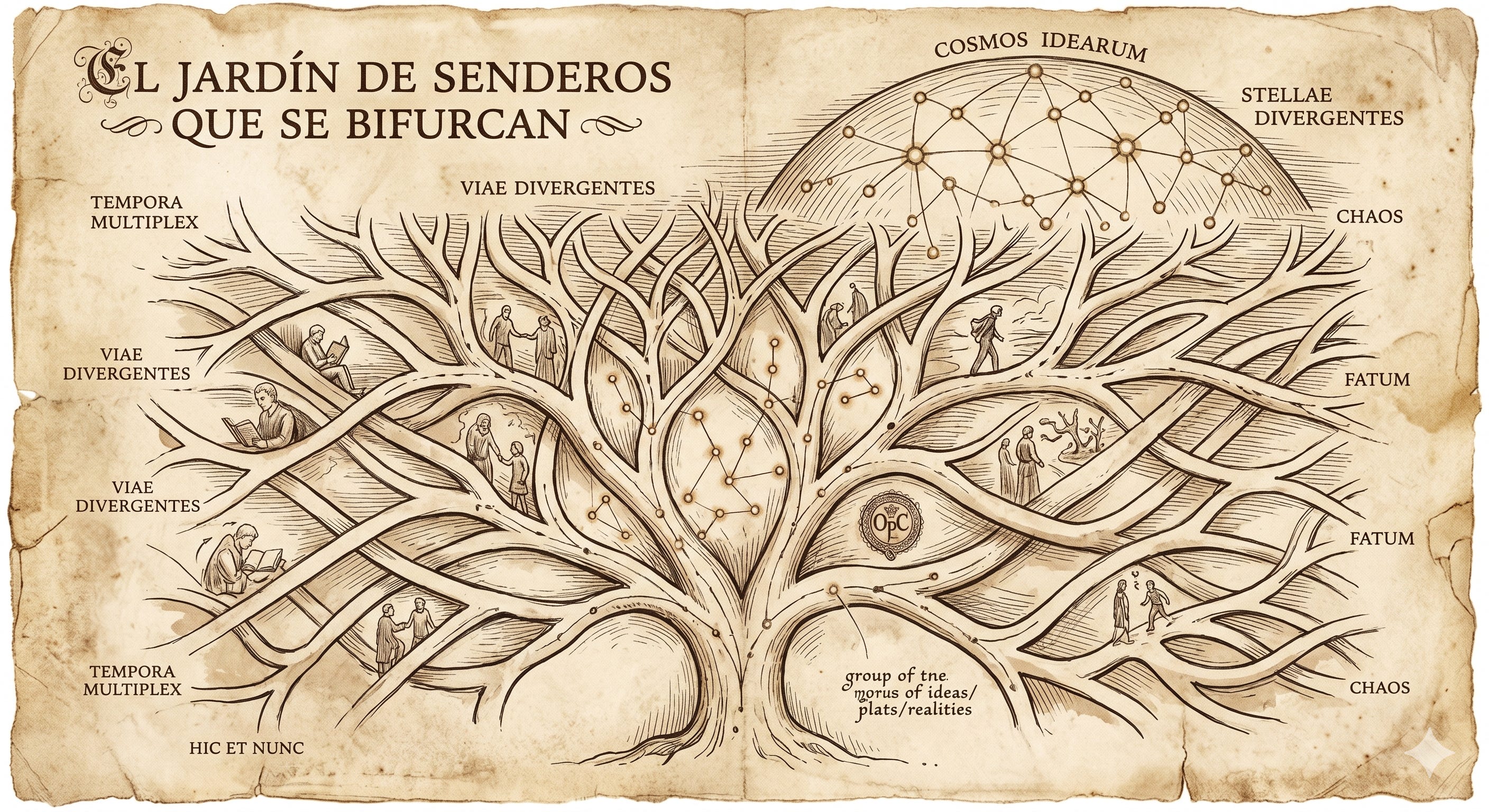
In The Garden of Forking Paths by Jorge Luis Borges, the main character reckons with the idea of a maze where the “fork” in the path is a decision to be made. Thus they confront an infinite number of possible outcomes and destinations in the maze of time that surrounds them. I reckon that the AI train now entering the cultural station is an institutional maze within a larger societal maze in which we find ourselves lost. An infinite trolley problem.
At this point, the general sense is that most people use or have used AI in some capacity, whether personally, professionally, or personally to assist them professionally. I also anecdotally sense that people working on the collections management side of art and culture think that AI will not replace their jobs. According to Borges, taking only left turns more efficiently delivers you to the center of the maze. We are at the forking path, but what is the left turn?
The CEO of Arternal, Sean Green, tied an unintentionally cautious bow on the conference program speaking about the subject. His company just released a product called Reggie that does the busy work for the registrar. To his immense credit, Sean publicly acknowledged the intense work of the registrar while researching the product. Further to his credit, he stated that registrars do not get credit when operations go well (only when they go poorly), something all registrars know but humbly bury in deep storage next to those pieces that we cannot be seen to deaccession. We just need a hug occasionally. Reggie culminates this research in a gallery-oriented agentic AI platform that purports to catalog, get shipping quotes, and manage consignments via a chat interface. In my mind, this product is as inevitable as the rising sun, but how will it affect your job in the field?
I have recently written not one but two 3000+ word articles that I have not published because they did not feel right (hence the delay in putting out a fresh, seasonal offering). However, the research put into those as-yet-unsurfaceable deep dives (I do not want them to get the bends) relates to this. In 2025, after the Brooklyn Museum announced layoffs of up to 50 staff citing 70% of their budget went to salaries, I started looking into museum budgets. Spending 70% of your operating budget on labor blows my mind, and I wanted to know if those numbers were normal. I now understand that that anomalous Brooklyn number does not represent the average, but the actual average does little to actually change perception. Now, we cannot always trust the available public data, sure, but I have found that museums spend roughly 45%–55% of their budget on labor/staff/salaries1. That is still crazy.
From Rippling, a payroll company, I present some comps for context:
Service-intensive industries allocate the most to payroll: healthcare averages 41%, marketing agencies 39%, and hospitality 30%, while manufacturing (12%) and retail (8% to 15%) run leaner due to automation and high sales volume.
The Metropolitan Museum of Art in New York had an annual budget in 2024 of $330,000,000 and an estimated staff budget of $175,000,000 or 53% of their budget. The Tate Modern in London had an operating budget of $115,000,000 of which $65,000,000 or 56.5% goes to salaries. The National Museum of Anthropology in Mexico City had a budget of $28,000,000 and a staff budget of $16,000,000 or 57.1%. This reliable data of these diverse institutions originates from public records. Add to this data persistent news of unionizing and striking museum employees primarily around the compensation issue, and one begins to welcome museum climate change at least.
Drink the Milk of Paradise
I get it, museums are not really businesses and do not fully operate in a market-driven economy. That said, they do have to generate money and balance a budget to survive. If you are a museum director trying to balance your budget, what is the low-hanging fruit? Why would you not look at ways to reduce the biggest, most problematic line item in the budget? How do you reduce the cost of labor? I do not want to suggest that AI is the answer (What do I know? I do not run a museum), but why would it not be a possible answer? Reggie has entered the chat.
In August of 2023, when the British Museum announced the theft of about 2,000 gems from its collection, they had an estimated 2.4 million uncatalogued or partially cataloged objects. How could they possibly afford the resources to complete this monumental task in the existing economic climate? However, to not address the issue actively endangers the one of the world’s most important collections as evidenced by the thefts. A tool such as Reggie would gladly assist the registration department and expedite the cataloging in this optimistic use case.
If you are one of the many who feel overworked, you might welcome a tool that augments your capacity to do more with less. I want a way to take a photo of an object and AI to tell me, with x% of certainty, as much information about the object without having to manually enter the data myself. I really dislike database work if you cannot tell, but it is foundational to any object and collection as a store a value and pillar of safety. Perhaps the British Museum’s situation is an outlier, too. Found in this collection is the question of will AI replace the registrar instead of enabling them?
All the existing platforms assure us that they are “human-in-the-loop”, or HITL to use the lingo, but if Reggie or a comparable solution becomes so easy to use, then that HITL does not have to have a master’s degree in museum studies and make $85,000 a year plus health insurance and a matching 401k. Or, the department may simply shrink from 10 master’s degrees to the 7 or to the 5 that understand prompting well enough to do the work of 1.67 or 2.3 registrars.
Curators Are Next
Because registrars and curators love to troll each other (in good fun, right? Right?), I joke to colleagues that a Spotify-generated playlist such as “RapCaviar” or “Today’s Top Hits” or “Viva Latino“ is AI cosplaying a curator. By the way, that is not even really a joke. Doctors use AI to review scans and x-rays to find medical anomalies that humans often miss. Similarly, the Met uses AI for “enhanced cognitive discoveries” where, like in medicine, the agent seeks out visual relationships left undiscovered by humans. Why not prompt the computer to organize an exhibition based on these discoveries? I personally look forward to Claude developing a show called “If It Ain’t Baroque, Don’t Fix It”.
Kidding tragically aside, the prompted agent will then create the text for the wall labels, the catalog essays, use an AI voice to create an audio guide, create the layout based on the gallery floor plans, create a coherent exhibition design, update the website, and generate a prioritized task list that integrates with Asana or Monday so the designated surviving exhibition staff each receive their instructions. One person can organize this in days or weeks instead of tens of people in months or years. I will also point out that curators get paid much more than registrars, so their loss will make more of a positive impact on the institution’s bottom line.
May I present just one cozy list of AI tools compiled by Duke University for art, art history, and research:
EBSCO’s AI-Enhanced Search fee
Includes AI Insights and Natural Language Search (NLS).
Of course, most of my museum colleagues may have just spit out their matcha lattes and decided to proactively start the boutique hotel or book store they once considered an analog retirement project. From my point of view, however, the rise of AI’s presence has made it very clear that the current way of running museums (and galleries for that matter—more on that later) cannot continue to operate in the current way. My own professional motto is “collections do not get smaller”. We will continue to need help to manage this expanding universe which quite obviously outpaces current resources. It costs more just to exist in the world now than 10 years ago but wages do not always reflect that inflation. We should all look for solutions like we look for change in the couch cushions.
If The Garden of Forking Paths views the world as a labyrinth and every decision made marks another turn in the maze, all possible outcomes eventually exist because the decisions never end.
Then I reflected that everything happens to a man precisely, precisely now. Centuries of centuries and only in the present do things happen; countless men in the air, on the face of the earth and the sea, and all that really is happening is happening to me.
A Constellation of Small Businesses
As the Art Business Conference repeatedly highlighted, the majority of galleries are small to mid-sized businesses. They maintain relatively small staffs and must carry the heavy financial burden of employees, fairs, exhibitions, storage, and the physical spaces themselves. Add to this numerous recent high-profile closures which, to be fair, do not all result from economic pressure. Nonetheless, the pressure is real and has real consequences, gallery death. These topics also drove conversation at the conference as galleries explained how they find additional revenue streams that have enabled them to survive.
Sure, pressure makes diamonds, but it also makes espresso. I have no doubt that the pressure will pack a lot of homogeneously-ground, shade-grown (thrown?) coffee into a thimble of filtered Alpine water to create a highly concentrated infusion that represents the business. Do more work with fewer and fewer people: the financial pressure that makes a highly concentrated, specialized staff. The largest gallery in the world, Gagosian, only has about 300 employees world wide. By contrast, Walmart, the largest company in the world by number of employees has about 2.1 million.
Does this mean that art fairs will evolve into unmanned vending machines? Does it mean that galleries will only exist online and run by an AI agent? In all likelihood, they will occupy a space on a spectrum between the vending machine and the full-service, in-person advisory.
For example, the recent grad or the executive assistant will use Reggie or something similar to manage the collection and sales instead of an actual registrar and thus feasibly combine 2 jobs into 1. Less expensive and less specialized employees result from these efficient, frictionless tools that guide you through the workflow. Espresso can satisfy on its own, but we usually augment it with milk, sugar, and/or water to manage that innate acidic intensity — a small staff with technology on top in a frothy, heart-shaped pattern completed by a partition down the middle. That is a latte to reflect on (forgive me).
We vulture around 2 themes: the immediate situation—job loss—and an existential question—how does the industry adapt to persevere? One of the beautiful, frustrating obstacles of the cultural sector is how inefficient it usually is. Human-oriented and custom solutions require vastly more resources. People get tired, need vacations, get sick, sleep at night, and need to get compensated. You have to treat everyone and everything individually instead of as a group, thus we rarely get to make batch updates. People who work in technology (especially those from the outside the field), like forty-niners prospecting ironically in Silicone Valley, view the innate inefficiencies as multi-billion-dollar opportunities and create businesse to reduce the stress, streamline processes, and make more money. I include myself in this category while also recognizing the aesthetics of inefficiency (I am a balance-seeking Libra after all). Still, we must also recognize that we live in a phase of [probably constant] transition trying to decide how much of our job to give over to a machine. I believe that we actually should outsource some aspects of work to the machines for the sake of the collections.
Belief in a Higher Power
I have not—and will not—get into appraisals, valuations, market analysis, or any of the other AI uses discussed at the conference. Collections management SAAS products alone make the humbling point. I do feel that sector-scale adaptations require a framework of principles that facilitate decision making on this and other subjects. Humans alone must create a belief system to comprehend and manage the machines. This is the most human thing we can do right now.
For example, when making realistic decisions about sustainability practices, a viable option according to my belief system has to 1) benefit the health of the object, 2) reduce costs, and 3) reduce emissions (in this order). Benefiting the object relates to institutional mission. Reducing costs means it becomes a viable, scalable solution (at the end of the day, money matters more than principles). And, reducing emissions is the actual goal. Choosing to not ship an object perfectly embodies this criteria, but improving HVAC efficiency realistically exemplifies this.
Similarly, for AI adoption, we must create a framework and deliberately decide where humans intersect. No, we will not all agree on this, but avoiding layoffs on their own does not amount to a good reason to avoid artificial intelligence. I believe this because that approach does not always serve the objects and mission.
For me, the objects have to come first. Missions should direct the flow of water and use it to power the mill. Understanding where humans excel and where they fall short imparts further wisdom. We can debate this point ad nauseam, but I think if an institution can do 80% of a human’s work (or maybe even less) with 20% of the resources, they will. Institutions need their own principles that instruct their actions regarding AI integration. For some, their mission seeks to find the best young artists, for others it means to produce the best scholarship, and perhaps for others, they just intend to move more product. Whatever the reason, institutions will need their own matrices to guide decision-making with respect to intense outside influences such AI that impose themselves on the work we do.
A possible structure could align with your collections management policy (if you want appease the collections management gods). See this starting point below:
Mission
Core values
To the field
To staff
To the collection
Authority
Accessibility
Ethics (Start with standards set by professional associations)
You get the idea.
The Fork in the Path
Again, from The Garden of Forking Paths:
All mysteries are solutions in themselves.
Yogi Berra also proclaimed:
When you come to a fork in the road, take it.
Is the solution we seek the question itself? Or, should we prompt an AI chatbot about how to move forward with AI? I have made peace with the idea that computers can do some aspects of collections management better than humans, and consequently, this will lead to some job loss. And while AI may occasionally hallucinate, so to do the humans that think that jobs will remain the same. The highly-specialized, deeply-experienced experts among us will either directly or indirectly train these agents to eventually replace ourselves. The non-specialist will soon do the work of the expert. Still, if we seek to preserve these collections that represent the patrimony of humanity, should we not welcome the tools that do a better job than us? We stand at the fork in the road that everyone, not just institutions face. It is kind of fun getting the chance to figure this out.
This is my own online research done with the ironic help of AI that I will somehow release some day in some form. Trust me, it may or may not be reliable. :)
Really thoughtful take as always. Your point about needing a clear framework for adoption really resonated. Without it, decisions risk being reactive rather than mission-driven. It feels less like replacement vs. resistance, and more like a rebalancing of where human judgment adds the most value, which is the ultimate point in any evolution. Loved all the puns too!